Omni-iEEG: A Large-Scale, Comprehensive iEEG Dataset and Benchmark for Epilepsy Research
ICLR 2026
Chenda Duan* , Yipeng Zhang* , Sotaro Kanai , Yuanyi Ding , Atsuro Daida , Pengyue Yu , Tiancheng Zheng , Naoto Kuroda , Shaun A. Hussain , Eishi Asano , Hiroki Nariai , Vwani Roychowdhury
UCLA Samueli School of Engineering , UCLA Mattel Children’s Hospital, David Geffen School of Medicine , Children’s Hospital of Michigan, Wayne State University School of Medicine , * Equal Contribution
-
TL;DR:
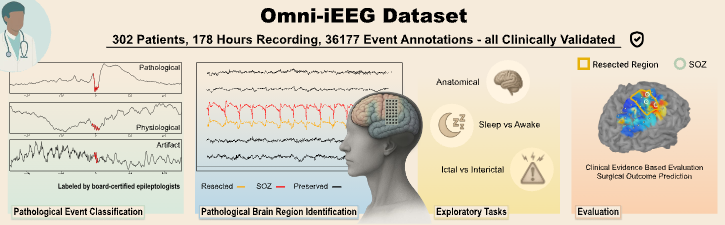
Omni-iEEG is the first large-scale, harmonized intracranial EEG dataset,
comprising 302 patients, 178 hours of recordings, and 36K expert annotations.
It establishes clinically meaningful and unified benchmarks with standardized evaluation
metrics to bridge clinical neuroscience and machine learning.
Dataset Overview
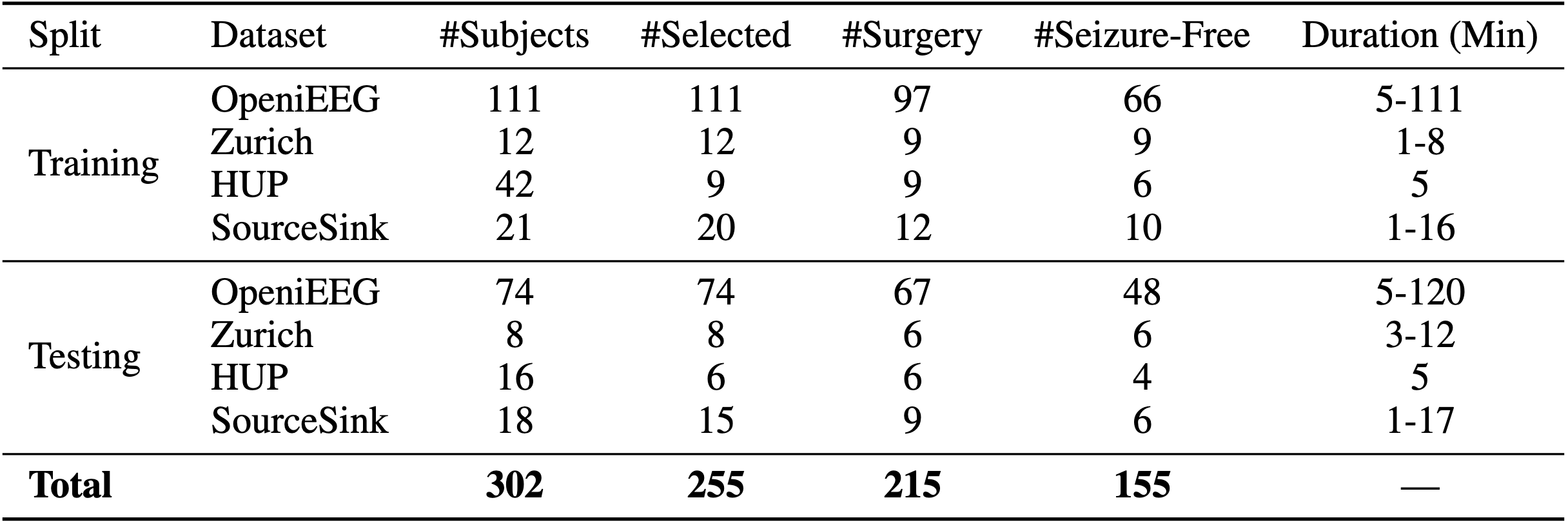
Omni-iEEG integrates recordings from eight epilepsy centers with harmonized clinical metadata (SOZ, resection regions, surgical outcomes, anatomical labels). Data will be released in BIDS format with an accompanying utility library on Github. We will also released the data in hugginface for easier access.
Event Annotation
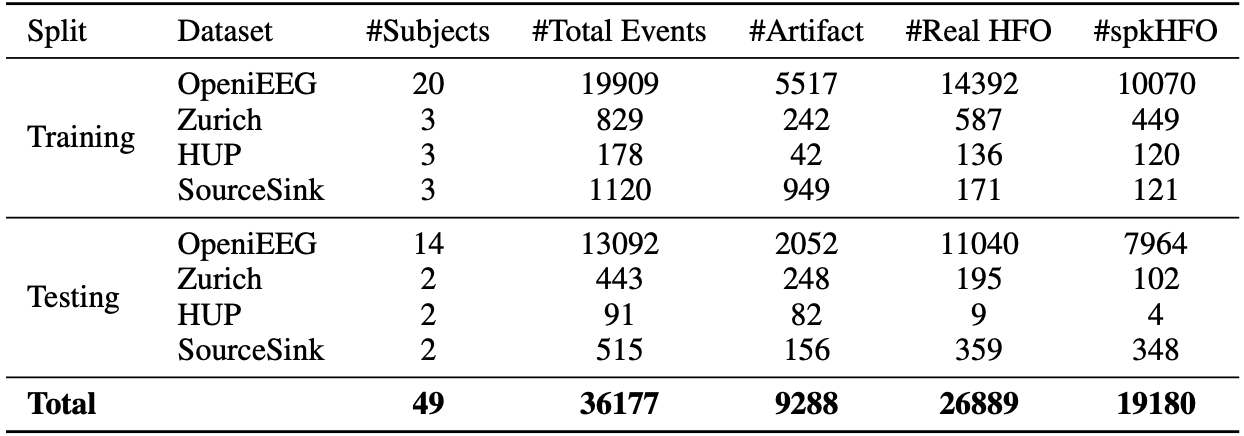
Over 36,000 high-frequency oscillation (HFO) events were annotated, combining new and previously published events. Candidate events were detected with three established algorithms (STE, MNI, Hilbert) and reviewed by four board-certified epileptologists. Each event was labeled as artifact, non-spkHFO, or spkHFO.
To ensure quality, annotators first calibrated on a shared set, then labeled independently. Inter-rater agreement was high (Fleiss’ κ = 0.93), reflecting strong consistency and clinical reliability. All signals were resampled to 1 kHz and standardized with bipolar montage where appropriate.
Benchmark Tasks
Task 1: Clinical prior-driven pathological event classification (spkHFO vs non-spkHFO vs artifact).
Task 2: Pathological brain region identification (SOZ vs normal channels, outcome prediction).
Exploratory Tasks: Anatomical location classification, Ictal period identification, Sleep–Awake classification.
Task 1:Pathological Event Classification
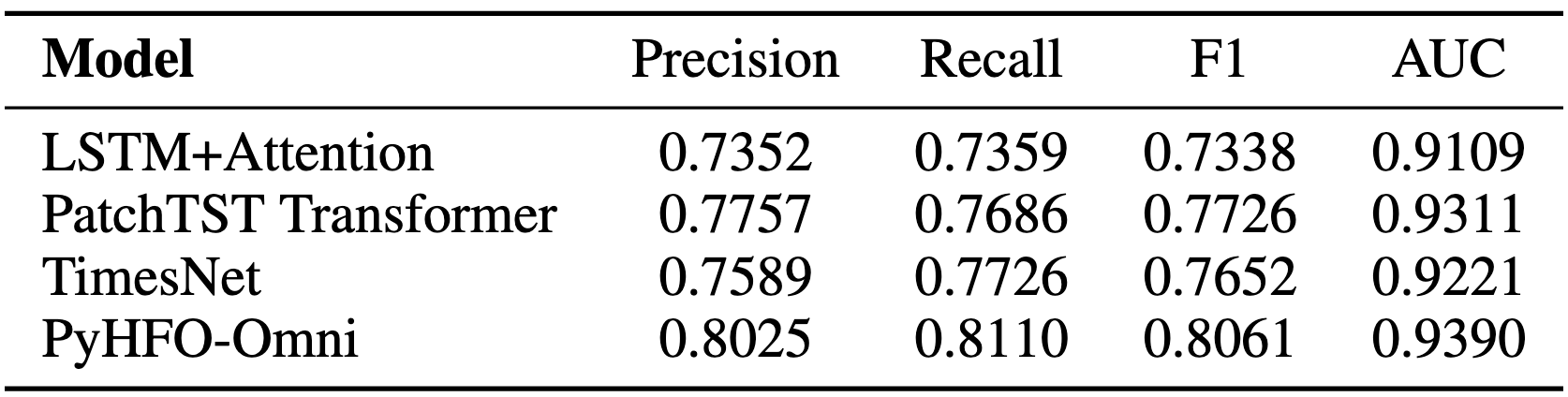
We benchmark recent competitive baseline event classification methods. PyHFO method trained on Omni-iEEG achieves the highest F1 (~0.81), demonstrating strong performance on spkHFO detection.
Pathological Brain Region Identification
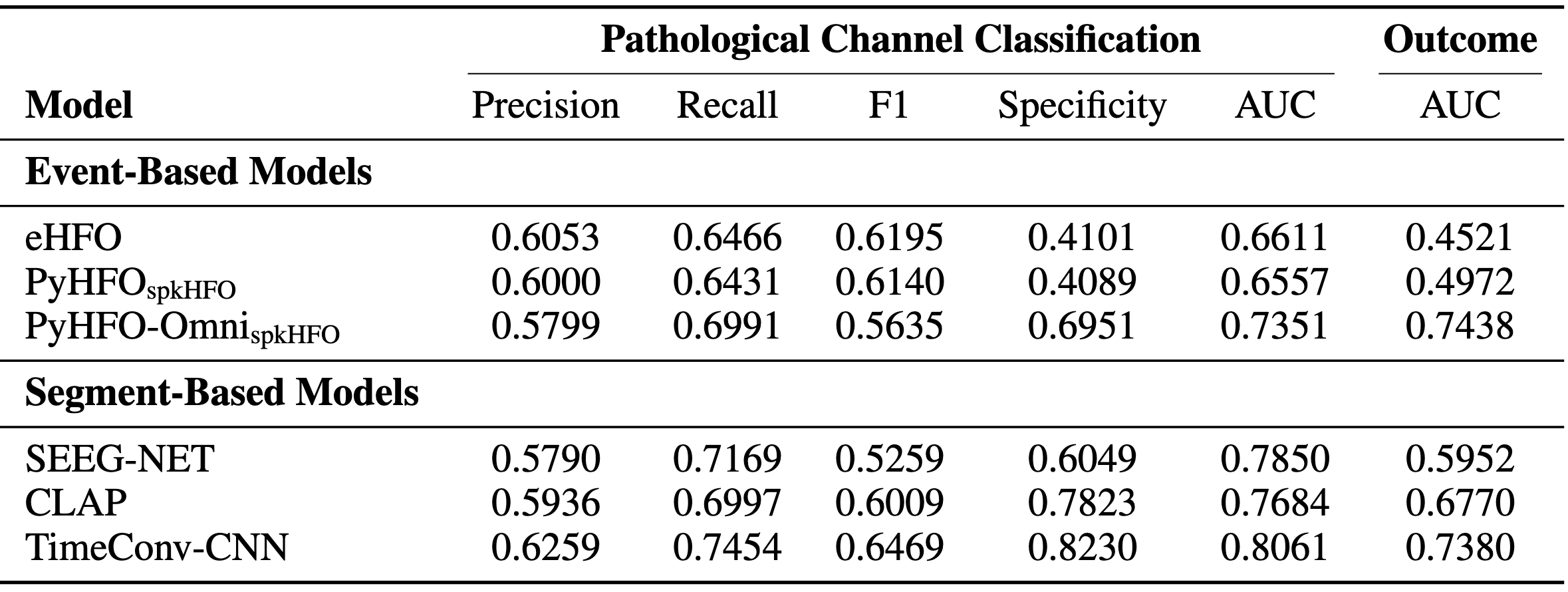
Both event-based and segment-based models are evaluated. Segment models (TimeConv-CNN, CLAP, SEEG-Net) achieve up to 0.81 AUC in pathological channel identification and correlate well with surgical outcome prediction.
Exploratory Tasks

Three exploratory tasks extend Omni-iEEG:
- Anatomical Location Identification: 5-class lobes and 12-class subregions.
- Ictal Period Classification: detect ictal vs interictal periods.
- Sleep–Awake Classification: identify vigilance states in invasive recordings.
Pretrained audio models (CLAP) perform strongly (e.g., F1 = 0.92, Acc = 0.93 on ictal classification), while CNNs remain competitive.
Conclusion
Omni-iEEG provides a unified, clinically validated foundation for data-driven epilepsy research. It enables systematic benchmarking, improves reproducibility, and opens new research directions at the intersection of clinical neurophysiology and AI.
Reference
@inproceedings{duan2026omniieeg,
  title={Omni-iEEG: A Large-Scale, Comprehensive iEEG Dataset and Benchmark for Epilepsy Research},
  author={Duan, Chenda and Zhang, Yipeng and Kanai, Sotaro and Ding, Yuanyi and Daida, Atsuro and Yu, Pengyue and Zheng, Tiancheng and Kuroda, Naoto and Hussain, Shaun A. and Asano, Eishi and Nariai, Hiroki and Roychowdhury, Vwani},
  booktitle = {International Conference on Learning Representations (ICLR)},
  year      = {2026}
}